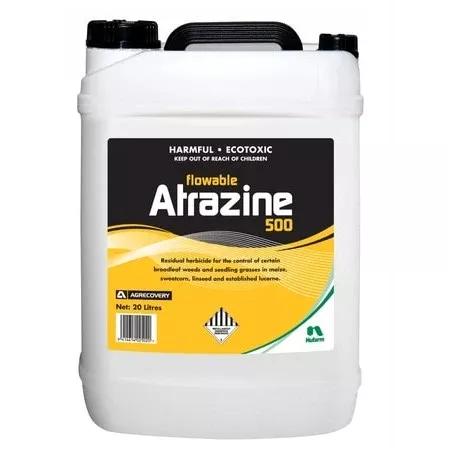
Atrazine 500 is a residual Herbicide for the control of Fathen, Black Nightshade, Willow Weed and other Broadleaf Weeds in Maize, Sweetcorn, Linseed and established Lucerne. Highly effective Herbicide for Pre-emergence or Post-emergence Broadleaf Weed control.
Active Ingredient:
900 g/L Atrazine in the form of a Water Dispersible Granule.
How It Works:
“Flowable Atrazine 500 is absorbed through leaves and roots and acts best on young Weeds as a post-emergence spray.”Flowable Atrazine 500 blocks photosynthesis and susceptible Weeds stop growing and die. It works best on small actively growing Weeds.
What It Controls: (Controls Many).
– Broadleaf Weeds.
– Seedling Annual Grasses.
Common Examples:
– Fathen.
– Black Nightshade.
– Willow Weed.
– Redroot Amaranth.
– Apple of Peru.
Some Grass Suppression/Control:
– Summer Grass.
– Annual Grasses (especially in tank mixes).
– Resistant Fathen populations are known to exist.
Where It’s Used: (Registered Uses Include).
– Maize.
– Sweetcorn.
– Linseed.
– Established lucerne.
Not Suitable For:
– Lawns.
– Gardens.
– General Pasture Weed Control.
Pre-emergence vs post-emergence:
Flowable Atrazine 500 can be used:
– Before Weeds emerge (pre-emergence).
– Shortly after Weeds emerge (early post-emergence).
The Label Especially Recommends:
– Early post-emergence.
– Weeds under 2 cm tall.
Moisture Is Critical:(The Label Strongly Stresses).
“Moisture in the soil surface is essential for good results.”.
– Without rainfall or soil moisture weed control drops significantly.
Application Rates: (General Examples).
Maize & Sweetcorn:
Typical Rates:
– 1.5–3.0 L/ha depending on Weeds and tank mix.
Water Rates:
– 200–400 L water/ha.
Linseed:
– Around 800 mL/ha in mixes.
Lucerne:
– 1.5–2.0 L/ha plus Paraquat for winter dormant Weed control.
Tank Mixing:(The Label Says It Is Commonly Mixed With).
– Grass Herbicides.
– Paraquat Products.
– Other Broadleaf Herbicides.
Examples Mentioned:
– Roustabout®.
– Agritone®.
– Bonza® Wetting Agent.
– NOT compatible with Gramoxone® 250.
Crop Rotation Restrictions:(Very Important Label Warning)
Flowable Atrazine 500 residues can damage sensitive follow-on Crops including:
– Tomatoes.
– Cucurbits.
– Brassicas.
– Lettuce.
– Beetroot.
– Beans.
Flowable Atrazine 500 can persist in soil for months.
Spray Drift Warning:(The Label Repeatedly Warns)
“Spray drift may cause serious damage to other desirable Plants.”
Avoid Spraying:
– In wind.
– Near Gardens.
– Near Waterways.
Safety & Hazards:(Hazards Listed On Label/SDS)
– Harmful if swallowed.
– May damage kidneys through repeated exposure.
– Very toxic to aquatic life.
– Toxic to soil organisms and wildlife.
PPE Required:(The Label Requires)
– Waterproof gloves.
– Overalls.
– Boots.
– Avoid inhaling spray mist.
Resistance Management:
Flowable Atrazine 500 is a Group 5 Herbicide.
The label warns resistant Weeds already exist, including:
– Fathen.
– Willow Weed.
– Repeated use alone increases resistance risk.
Key Mistakes To Avoid:
– Spraying large Weeds, best on very young weeds.
– Dry soil conditions, needs moisture to activate.
– Spray overlaps can injure crop.
– Ignoring residual carryover Can damage future crops.
– Repeated solo use Increases resistance pressure.
Bottom Line:
Flowable Atrazine 500 Is:
– A classic Maize Herbicide.
– Strong on Broadleaf Weeds.
– Useful both pre- and early post-emergence.
– Long-lasting in soil.
– Moisture-dependent.
But:
– It carries environmental persistence risks.
– Requires careful crop rotation planning.
– Resistance management matters.
Caution:
Use strictly according to label directions.
Available in 20L, 200L, 1000L.
Customers also search for Gesaprim.
Registered under the ACVM Act: P003001