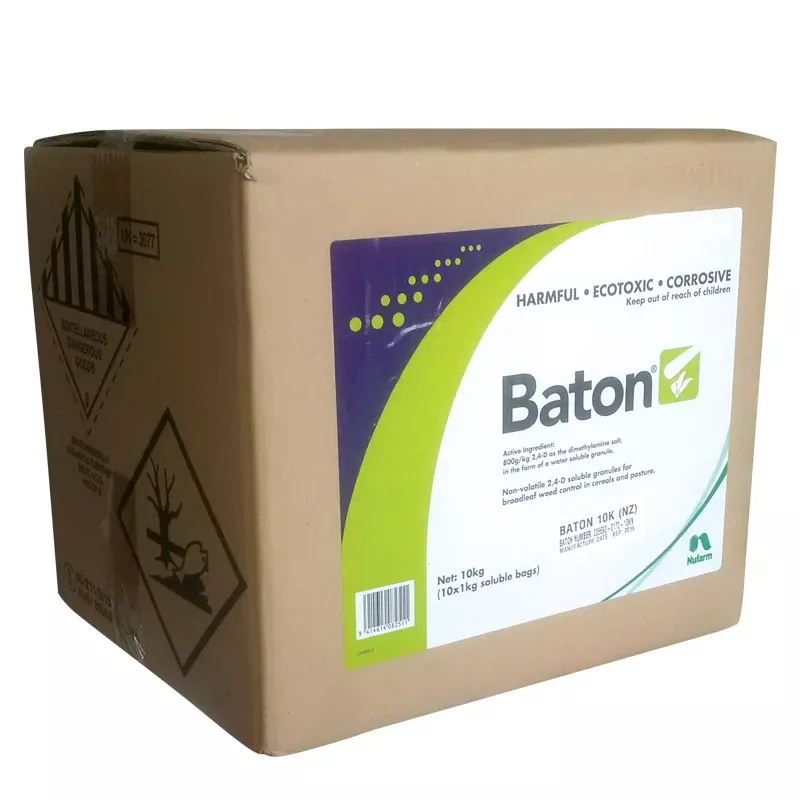
Baton 800WSG is a non-volatile Herbicide in a 2,4-D formulation for Broadleaf Weed control in Cereals and Pasture. Baton 800WSG is low in odour, while improving Clover safety. Ideal for Aerial and Boom Spraying.
Active Ingredient:
800g/kg 2,4-D in the form of a Water-soluble Granule..
Key Feature Of This Product: (Unlike Ester-based 2,4-D Products).
– Low odour.
– Non-volatile.
– Better Clover safety.
– Lower drift vapour risk.
This Makes It Safer Around:
– Sensitive Crops.
– New Pasture.
– Clover.
– Compared with older 2,4-D ester formulations.
What It Controls:
Controls many Broadleaf Weeds including:
– Ragwort.
– Thistles.
– Pennyroyal.
– Wild Carrot.
– Mustards.
– Docks.
– Buttercups.
Works Best On:
– Small.
– Young.
– Actively growing Weeds.
Where You Can Use It: (Registered Uses Include).
– Established Pasture.
– New Pasture.
– Cereals (Wheat, Barley, Oats).
Not Suitable For:
– Gardens.
– Vegetables.
– Ornamentals.
– Sensitive Crops.
How It Works:
BATON 800WSG Is absorbed through foliage and mimics plant growth hormones causeing uncontrolled growth and plant death.
It Mainly Affects:
– Broadleaf Weeds while Grasses tolerate it.
Application Rates: (General Label Guidance).
Ground Spraying:
– 100–300 L water/ha.
Aerial Spraying:
– 30–100 L water/ha.
Knapsack:
– 50 g per 10 L water.
Spot Spraying:
– 500 g per 100 L water.
Higher Water Rates Are Recommended For:
– Larger Weeds.
– Dense infestations.
Mixing instructions: (The Label Says).
– Fill tank about two-thirds with water.
– Start agitation.
– Add BATON 800WSG granules.
– Continue agitation while filling tank.
– Ensure product fully dissolves before spraying.
Best Timing:(Best Results Occur When).
– Weeds are seedlings or young rosettes and Plants are actively growing.
Avoid Spraying When:
– Drought-stressed Weeds.
– Frosted Weeds.
– Hardened mature Weeds.
– Large Perennial Weeds often need repeat treatment.
Clover Safety:(One major advantage).
Improved clover safety compared with ester 2,4-D products.
But:
– High rates or poor timing can still suppress Clover.
Spray Drift Warning:(The Label Strongly Warns)
“Spray drift may cause serious damage to other desirable plants”.
The Label Specifically Advises:
– Use low-drift nozzles.
– Avoid fine droplets.
– Spray in light steady winds only.
– Be especially careful if sensitive vegetation is within 0.5 km.
Safety & Hazards:
The Label Classifies BATON 800WSG As:
– Harmful if swallowed or inhaled.
– Causes serious eye irritation.
– May cause allergic skin reactions.
– Causes organ damage through repeated exposure.
– Very toxic to aquatic life.
PPE Required:(The Label Requires).
– Waterproof gloves.
– Boots.
– Overalls.
– Eye protection.
Also:
– Avoid breathing dust or spray mist.
Environmental Risks:(The Label Warns It Is).
– Very toxic to aquatic life.
– Very toxic to soil organisms.
– Toxic to terrestrial vertebrates.
Avoid:
– Waterways.
– Runoff.
– Overspray into Shelterbelts or Gardens.
Resistance Management:
– Repeated use of Group 4 Herbicides can lead to resistant Weeds.
The Label Notes:
– Some Perennial Weeds require repeat spraying.
– Tank mixing may improve spectrum and resistance management.
Key Mistakes To Avoid:
– Spraying mature weeds as control drops significantly.
– Fine spray droplets as it Increases drift risk.
– Spraying stressed Weeds as it can result in poor uptake and poor kill.
– Expecting Perennial Weeds to die in one pass.
– Repeat applications may be needed.
– Planting sensitive Crops too soon.
– The label notes possible short-term soil activity.
Bottom Line:
BATON 800WSG is:
– A modern low-volatility 2,4-D Herbicide.
Excellent For:
– Pasture Weed control.
– New Pasture.
– Cereals.
– Better on Clover safety than Ester formulations.
– Lower odour and lower vapour drift risk.
But:
– Still capable of serious off-target damage if misused.
– Requires careful drift management.
Caution:
Use strictly according to label directions.
Available in 1kg, 10kg, 20kg.
Registered under the ACVM Act: P009585