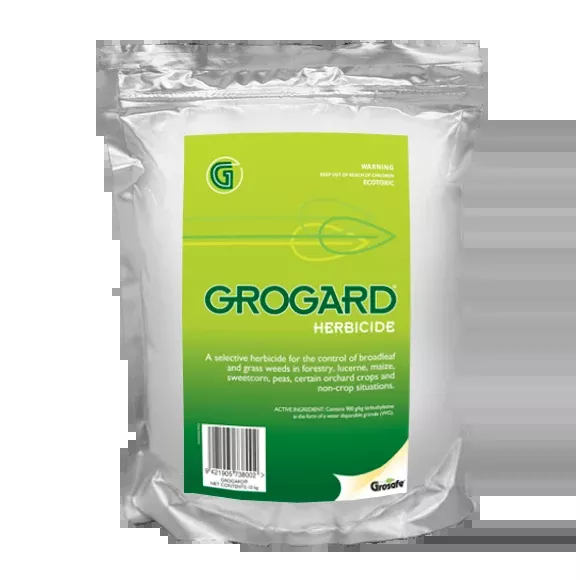
GROGUARD is a Selective Herbicide that provides residual and post‑emergence control of Broadleaf and Grass Weeds in Forestry, Lucerne, Maize, Sweetcorn, Peas, certain Orchard Crops andnon-crop situations.
ACTIVE INGREDIENT:
Contains 900 g/kg Terbuthylazine in the form of a Water Dispersible Granule (WG).
Weed Spectrum & Limitations:
Controls numerous Annual Grasses and Broadleaf Weeds:
– Barley Grass.
– Black Nightshade.
– Browntop.
– Catsear.
– Chickweed.
– Clovers.
– Cocksfoot.
– Dove’s Foot.
– Fat Hen.
– Kentucky Bluegrass.
– Lotus.
– Nodding Thistle.
– Poa spp.
– Redroot.
– Scotch Thistle.
– Seeding Gorse.
– Shepherd’s Purse.
– Storksbill.
– Sweet Vernal.
– Willow Weed.
– Yorkshire Fog.
DOES NOT CONTROL deep‑rooted Perennial Grasses (Paspalum, Kikuyu, Indian Doab) without tank‑mix adjustments.
Crop-specific Rates and Notes:
LUCERNE (Established):
– 830 g – 1.1 kg/ha in 200–300 L/ha.
– Stands ≥2 years; mix with 2–3 L Paraquat 20% a.i.; apply when dormant and closely grazed; mid‑winter preferred.
– Use higher rate for Clovers/longer residual; do not exceed higher rate.
– Withholding Period: Lucerne – 28 days.
ORCHARDS (Pipfruit, Citrus, Grapes, Kiwifruit):
– 3.3–4.4 kg/ha in 200–300 L/ha.
– Do not apply to Trees/Vines <1 year old or Plants in light sandy soils.
– Pre‑emergence: spring to weed‑free soil.
– Post‑emergence: tank mix with Glyphosate for Established Weeds.
MAIZE & SWEETCORN:
– 1.7–2.0 kg/ha in 200–300 L/ha.
– Pre‑Emergence application after sowing but before emergence; add suitable Herbicide for Grass Weeds.
PEAS:
– Pre‑emergence rate 830 g – 1.1 kg/ha in 200–300 L/ha to freshly worked seedbed after sowing but before emergence (avoid light sandy/low organic soils).
– Post‑emergence rate 1.7 kg/ha in 200–300 L/ha to actively growing Weeds ≤5 cm; add non‑ionic surfactant.
– Note: for Triazine‑Resistant Weeds (e.g., Fat Hen) add appropriate Post‑emergence Herbicide (e.g., Dicamba).
FORESTRY (Radiata Pine, Douglas Fir, Specified Eucalyptus):
– Broadcast 8.3–11.0 kg/ha in 150–300 L/ha (best on Bare Ground or Weeds <10 cm before spring growth).
– Spot: apply 42–55 g per litre spray solution at 20 mL spray solution per m² (≈0.83–1.1 g/m²).
– For Predominant Grass Weeds, Tank‑mix with Clethodim 240 (label rates) + Result Sprayingoil; Use higher GROGUARD rate for Gorse Seedlings.
INDUSTRIAL WEED CONTROL (Roadsides, Footpaths, Pipelines, Storage/Waste Sites):
– Apply 8.3–11.0 kg/ha. Tank‑mix Glyphosate for existing Vegetation Knockdown and Deep‑rooted Perennials.
Calibration/Example Spot Rates:
Broadcast Forestry: 8.3–11.0 kg/ha in 150–300 L/ha.
– Spot: 42–55 g per litre spray solution; apply 20 mL spray solution per m² (≈0.83–1.1 g/m²).
Hazard Classifications & Warnings:
Acute oral toxicity Cat 4; Acute inhalation toxicity Cat 4; Aquatic acute & chronic Cat 1; hazardous to Soil Organisms; hazardous to Terrestrial Vertebrates.
WARNING: Harmful if Swallowed or Inhaled.
– Very toxic to Aquatic Life and Soil Environment.
– Spray drift hazard — avoid off‑target movement.
– DO NOT apply directly into/onto Water.
Regulatory / Qualifications / Rcords:
– Person mixing/loading/applying must meet label qualifications (qualified as required by HSNO).
– Keep NZS 8409 records if ≥3 kg applied within 24 h and likely to leave area.
Personal Protection & Handling:
– Wear Overalls, Impervious Gloves and Eye/Face Protection when Mixing/Applying.
– Avoid inhaling Spray/Dust.
– Wash Hands and exposed Skin before Breaks/Meals and after Work.
– Clean Clothing/Equipment before reuse.
Storage & Transport:
– Store in original container, tightly closed, secure, dry and cool; follow NZS 8409.
– Stores>100 kg require signage, secondary containment and emergency response plan.
– Do not carry on passenger service vehicle.
First Aid:
– For advice call National Poisons Centre 0800 POISON (0800 764 766).
– IF SWALLOWED: rinse mouth, call poisons centre/doctor if unwell.
– IF INHALED: move to fresh air and rest.
– IF ON SKIN: wash with soap and water.
– IF IN EYES: rinse cautiously for several minutes; remove contact lenses and continue rinsing.
– Seek medical advice if symptoms persist.
Spillage & Emergency:
– Wear PPE, contain spills, absorb with inert material, collect in labelled sealed drums for disposal.
– Prevent contamination of drains/streams; warn local water authority if contamination unavoidable.
– Emergency response: 0800 CHEMCALL (0800 243 622).
Disposal:
– If possible use product according to label.
– Recycle empty packaging via Agrecovery or dispose at approved landfill.
– Avoid contaminating water supplies.
Ecotoxicity & Environmental Notes:
– Hazardous to Aquatic Organisms and Soil Organisms; avoid contamination of Water Bodies.
– Rain within 3 hours reduces efficacy; rainfall/irrigation within 1 week needed to optimize residual control for some uses.
Mixing & Application:
– For Pre‑Emergence: apply to Weed‑Free, freshly worked Seedbed.
– For Post‑Emergence: Tank‑mix with Glyphosate (for knockdown) where established Weeds exist; add non‑ionic surfactant for some Post‑Emergence uses as directed.
– Ensure Calibration of Equipment and use recommended Water Volumes (see Crop entries).
– For Forestry spot treatment, apply measured g/m² in sufficient water for coverage.
Resistance Management:
– GROGUARD contains GROUP 5 Triazine Herbicide (Terbuthylazine).
– Resistant Biotypes exist; avoid continuous use of same group and rotate/alternate Herbicide modes of action.
Application Timing & Efficacy Notes:
– Absorbed via Roots and Foliage; activity appears in 1–3 weeks.
– Rain within 3 hours reduces efficacy; rainfall/irrigation within 1 week may be necessary to activate residual control.
– For Pre‑Emergence apply to Weed‑Free soil; for Post‑Emergence control keep Weeds Small/Young for best results.
Caution:
Must be used strictly according to label directions.
Available in a 10Kg.
Registered under the ACVM Act: P009681