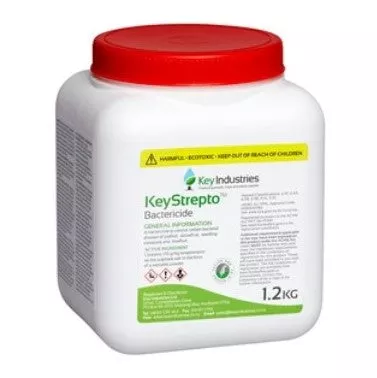
KEYSTREPTO™ A Bactericide to control certain Bacterial Disease of Pipfruit, Stonefruit, Seedling Tomatoes and Kiwifruit.
Active Ingredient:
Streptomycin (Antibiotic Bactericide).
Used for the control of important Bacterial Diseases in Horticultural Crops.
Application Rate:
– 60 g per 100 L water (100 ppm Streptomycin) for all listed Crops.
– Rates are based on high-volume Spraying to Runoff.
– Adjust dilution for Concentrate Spraying.
– Ground-based Foliar Application only.
Registered Uses:
Crop: Pipfruit (Apples & Pears).
– Disease:Fireblight (Erwinia Amylovora).
– Rate: 60 g/100 L.
– Key Directions: Apply only during high disease risk, mainly over Bloom. Maximum 3 sprays/season. Add Surfactant (10–12 mL/100 L) if needed.
Crop: Stonefruit.
– Disease: Bacterial Blast & Bacterial Spot (Pseudomonas Syringae).
– Rate: 60 g/100 L.
– Key Directions: Apply from green tip to Early Summer. Maximum 4 sprays/season. Autumn Spray before leaf fall if Disease Pressure is high. Use Copper during Dormancy.
Crop: Seedling Tomatoes.
– Disease: Bacterial Diseases.
– Rate: 60 g/100 L.
– Key Directions: Protective Sprays every 7–10 days while Disease threatens. Do not spray after transplanting. Disinfect Greenhouse Equipment between Crops.
Crop: Kiwifruit.
– Disease: Psa-V.
– Rate: 60 g/100 L.
– Key Directions: Surface spray only. Apply before infection events from Bud Break until before Flowering. Maximum 4 KEYSTREPTO applications and 6 antibiotic sprays total per Season. Alternate with other modes of action. Use Nu-Film-17 at 300 mL/ha. Copper Tank Mixes acceptable; do not mix with other Antibiotics.
Resistance Management:
– Use only when Disease Risk is High.
– Alternate with Products having different modes of action.
– Do not exceed the specified number of Applications.
– No more than 2 Consecutive Streptomycin Sprays on Kiwifruit.
– Thorough spray coverage is essential.
Withholding Periods: (WHP)
Crop: Apples & Pears.
– WHP: 35 days.
Crop: Apricots, Cherries, Nectarines, Plums.
– WHP: 35 days.
Crop: Peaches.
– WHP: 56 days.
Crop: Seedling Tomatoes.
– WHP: Do not apply after Transplanting.
Crop: Kiwifruit.
– WHP: Apply only from Bud Break until before Flowering.
Grazing Restriction:
– Orchard Grazing only after Harvest, when leaves are no longer present, and at least 3 Months after the last Application..
Bee Protection:
– By Law, cover or remove Beehives during Spraying.
– Hives may only be returned once Spray Deposits have completely dried.
Important Use Notes:
– Foliar/Surface application only.
– Do not apply to Kiwifruit when Flowers or Fruit are present.
– Consult export authorities regarding residue requirements before use.
– Avoid overuse to reduce the risk of antibiotic resistance.
– Ensure spray residues do not exceed New Zealand Maximum Residue Limits (MRLs).
Dangerous Goods:
– UN Number: 3077.
– DG Class: 9.
– Packing Group: III.
– Environmentally Hazardous Substance (contains Streptomycin).
Hazard Classification:
Human Health.
– Harmful if absorbed through the Skin.
– May cause Eye Irritation.
– May cause an Allergic Skin Reaction.
– Streptomycin can cause severe dermatitis in sensitive individuals.
– Repeated high oral exposure may cause organ damage.
Environmental Hazards:
– Very toxic to Aquatic Organisms.
– Do not apply directly to or into Water.
– Prevent contamination of Waterways, Drains, and Water Supplies.
– Harmful to terrestrial vertebrates, including birds and reptiles.
– Avoid off-target movement outside the treatment area.
Record Keeping:
– Use and record keeping are regulated under the ACVM Act 1997.
– Users must comply with the registration conditions supplied with the product.
– Full registration conditions are available from Key Industries.
Handling Precautions:
– Must be handled by a QUALIFIED HANDLER (current Growsafe Certificate).
Avoid:
– Skin Contact.
– Eye Contact.
– Inhalation of Dust or Spray Mist.
Wear:
– Protective Clothing.
– Goggles.
– Rubber Gloves.
– Wash Hands and Face after Handling and before Eating, Drinking, or Smoking.
– Wash contaminated clothing before reuse.
– Anyone developing skin irritation or a rash should stop handling the product and seek medical advice if necessary.
First Aid:
– Poisons Centre: 0800 POISON (0800 764 766).
If Swallowed:
– Do not induce Vomiting.
– Rinse Mouth.
– Seek Medical Advice.
If In Eyes:
– Flush immediately with Clean Running Water for at least 15 minutes.
– Remove Contact Lenses if easy to do.
If On Skin or Hair:
– Remove Contaminated Clothing.
– Wash thoroughly with Running Water.
– Seek Medical advice if irritation or Rash Develops.
Storage:
– Keep out of reach of Children.
– Store in the original tightly closed Container.
– Keep in a cool, dry, secure place away from Food and Feed.
– Protect from Freezing.
– Store in accordance with NZS 8409 – Management of Agrichemicals.
Application Equipment:
– Thoroughly flush Spray Equipment with Clean Water after use.
– Prevent contamination of non-target Plants and Waterways.
Container Disposal:
– Triple rinse Containers immediately after Emptying.
– Add rinsate to the Spray Tank.
– Crush and dispose of at an approved landfill or recycle through Agrecovery.
– Do not burn empty Containers.
Product Disposal:
– Use according to label directions.
– Dispose of unwanted Product through an approved Landfill if required.
Spill Management:
– Wear appropriate PPE.
– Prevent Spills entering Waterways.
– Absorb with Inert Material.
– Collect into suitable Waste Containers.
– Wash contaminated area with Water and Absorb Remaining Liquid.
– Dispose of Waste according to local regulations.
Conditions Of Supply:
– Product is manufactured under strict quality control.
– Performance is dependent on Correct Storage, Mixing, Weather, Application, and Crop Conditions.
– The manufacturer accepts no liability for damage arising from factors beyond its control.
Key Safety Reminders:
✔ Qualified Handler Required.
✔ Wear Gloves, Goggles, and Protective Clothing.
✔ Avoid Skin Contact and Inhalation.
✔ Keep away from Waterways.
✔ Triple Rinse Containers.
✔ Clean Spray Equipment after use.
✔ Follow ACVM Record-keeping Requirements.
Registered under the ACVM Act: P001369