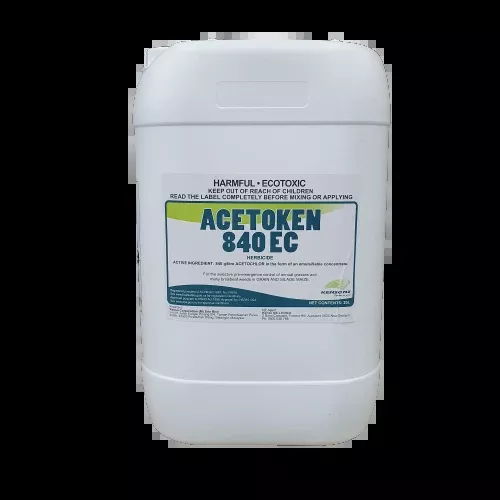
Acetochlor 840 is a selective Pre-emergence Herbicide for Weed control in Maize and Sweet Corn. Acetochlor 840 provides up to 10-12 weeks residual control of Annual and Broadleaf Weeds. Apply directly after planting will ensure chemical is absorbed through the shoots of emerging Weeds causing death.
Active Ingredient:
840g/L acetochlor in the form of an Emulsifiable Concentrate
What It Controls:
Controls:
– Annual Grasses (eg. Summer Grass, Barnyard Grass).
– Many Broadleaf Weeds (eg. Nightshade, Chickweed, Thistles).
Important:
– Works before Weeds emerge, not after.
– Provides residual control (10–12 weeks).
Where You Can Use It:
– Grain Maize.
– Silage Maize.
– Sweet Corn (in practice, similar products allow this).
Not For:
– Lawns.
– Pasture.
– General spraying.
– This is a Crop-specific Herbicide, not a general Weedkiller like 2,4-D.
How It Works:
– Absorbed by emerging shoots of Weeds.
– Stops growth before plants break the surface.
– That’s why timing is everything.
When To Apply: (CRITICAL).
Pre-emergence only:
– Apply immediately after planting Maize.
Before:
– Crop emerges.
– Weeds emerge.
– If weeds are already visible → too late.
Application Basics: (General Method).
– Boom spray over soil after plantingWater Rates (typical label style):
– Around 100–300 L/ha (common for this type).
Key Requirement:
– Needs moisture (rain or irrigation) to activate.
Without Rain:
– Effectiveness drops significantly.
Mixing & Compatibility:
Often Used With:
– Atrazine.
– Dicamba.
Tank Mixing:
– Expands Weed Control spectrum.
– Common in Maize programs.
Always:
– Follow label combinations.
– Do a jar test.
Safety & Hazards: (IMPORTANT).
From EPA classification:
– Harmful if swallowed.
– Causes skin and eye irritation.
– May cause allergic skin reactions.
– May cause long-term organ effects.
– Very toxic to aquatic life.
– This is not a “light” chemical—treat it seriously.
Environmental Risks: (Highly Toxic To)
– Fish.
– Aquatic organisms.
– Soil life.
Label Implications:
– Avoid waterways.
– Prevent runoff.
– Careful on slopes or heavy rain.
Spray Drift & Handling:
Even though it’s soil-applied:
– Drift can still affect nearby Plants.
Must:
– Use correct nozzles.
– Avoid wind.
– Apply evenly.
Resistance Management:
– Group 15 Herbicide.
Meaning:
– Repeated use alone → Weeds can develop resistance.
– Should be rotated or mixed with other modes of action.
Key Mistakes To Avoid: (common real-world issues).
– Spraying too late.
– Once Weeds emerge → poor control.
– No rainfall after spraying product just sits on soil.
– Using on wrong Crops can damage non-maize plants.
– Uneven spraying leads to patchy Weed control.
Bottom line:
– Designed for Maize only.
– Works before Weeds appear.
– Needs moisture to activate.
– Provides long residual control.
– Strong chemical → handle carefully.
Caution:
Must be used strictly according to label directions.
Available in 5L, 20L, 200L, 1000L
Customer search best price for Sylon
Registered under the ACVM Act: P009618
![PROFRAME HELMET MATTE [BLK] L](https://www.bestfixhardwareus.com/wp-content/uploads/2026/09/proframe-helmet-matte-blk-l.webp)